Audit Overview
Your store's untapped revenue potential — and how to unlock it
Why We Created This Audit
We analyzed zodiaconline.com the same way we've audited 350+ e-commerce stores — looking for the specific gaps between your current experience and what top-performing Fashion & Apparel stores deliver. Every finding in this report is a revenue opportunity backed by industry data and competitive benchmarks.
What We Analyzed
- UX & Conversion Design13 findings
- Technology & App StackPlatform + 3 apps
- Industry BenchmarksFashion & Apparel
Pages Analyzed
- Homepage3 findings
- Collection Pages2 findings
- Product Pages (PDP)5 findings
- Cart & Checkout3 findings
 This audit was prepared by Growisto — a CRO-led Website development team behind 167% conversion growth for Atomberg, 46% CR lift for TyresNmore, and 350+ e-commerce projects.
UX & Conversion Findings
Page-by-page analysis with visual comparisons against top Fashion & Apparel stores
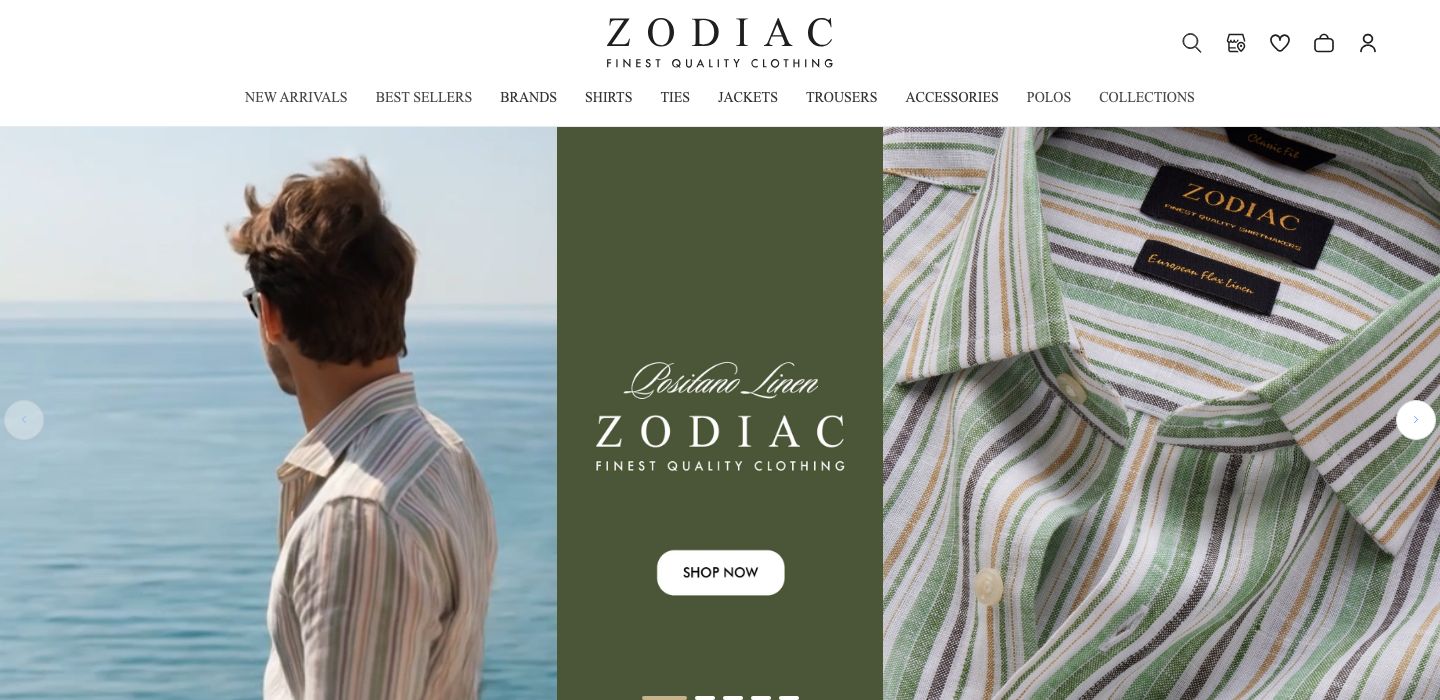
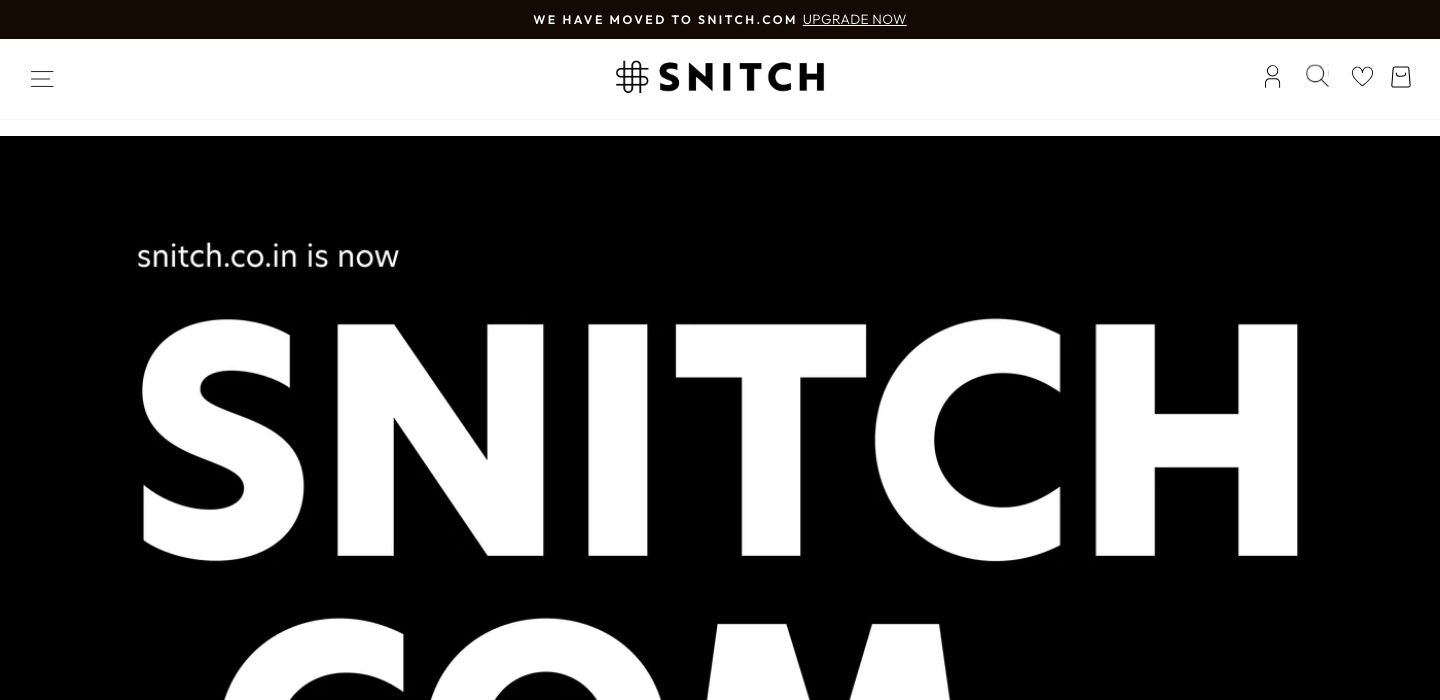
- Zodiac's homepage loads directly into a full-bleed hero image with no announcement bar above the navigation — a free, high-visibility slot for offers, shipping promotions, or credibility messages is unused.
- 9 out of 10 top fashion stores in India use an announcement bar to communicate free shipping thresholds, ongoing sales, or brand trust signals (e.g. '1M+ happy customers') — it is the first text a visitor reads.
- Competitors like Snitch and Powerlook run rotating bars communicating offers like 'Get 10% off your first order' and 'Free shipping above ₹999' — both of which Zodiac offers but does not surface prominently.
- Without an announcement bar, first-time visitors miss Zodiac's free shipping offer and return policy in their first second on site — two of the strongest conversion signals in fashion.
- Add a sticky announcement bar above the header with 1–2 rotating messages: (a) free shipping and free reverse pickup above ₹999, (b) an introductory offer or brand credibility claim ('Finest quality since 1971').
- Use a contrasting background (dark gold or deep navy) to visually separate it from the white header, ensuring it reads instantly without disrupting the brand aesthetic.
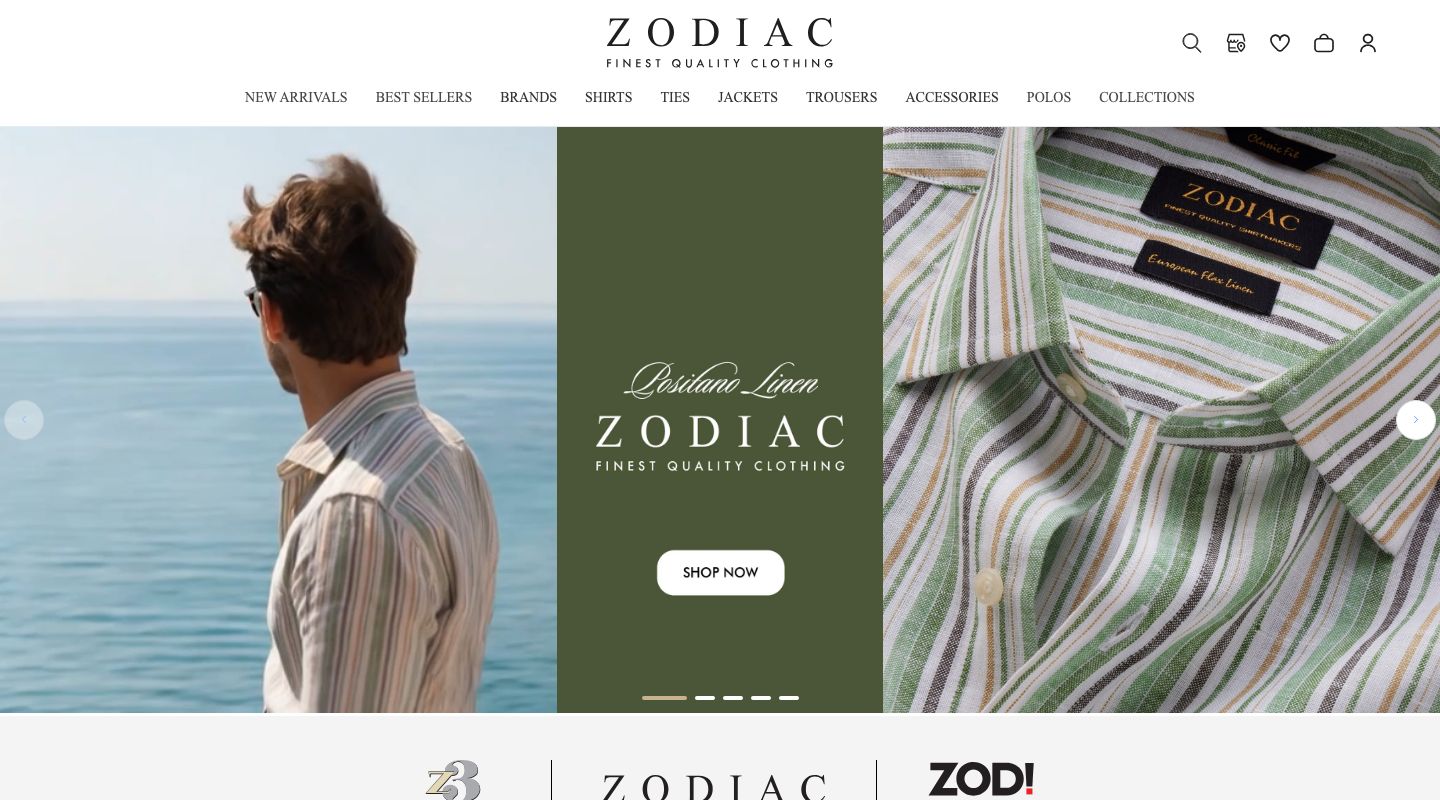
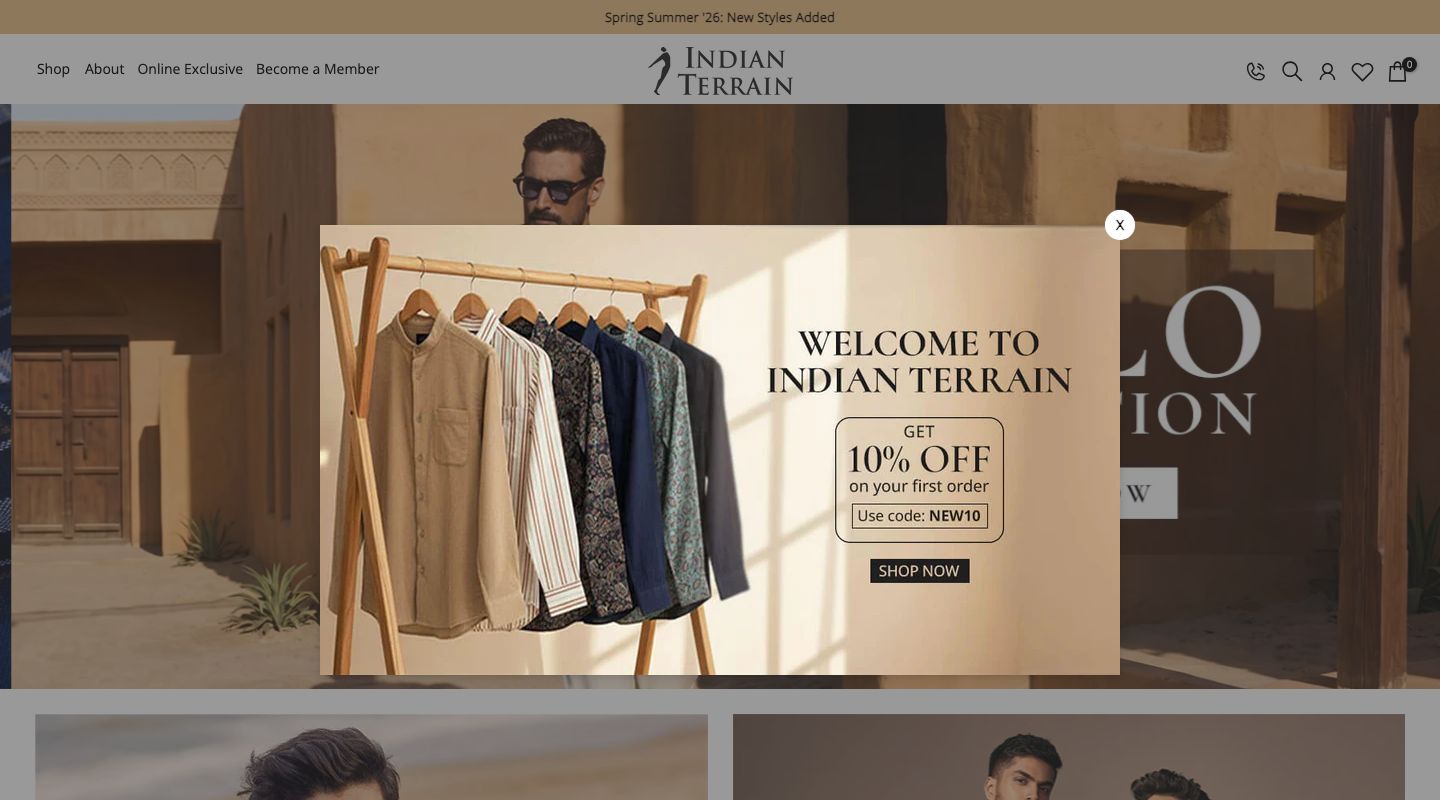
- Below Zodiac's hero section, there is no trust or USP strip communicating why a visitor should buy here versus a multi-brand retailer — attributes like '50+ years of craftsmanship', 'Giza 86 Egyptian cotton', or 'Free returns' go unstated.
- Indian Terrain and Powerlook both feature a 4-icon strip (e.g. Free Delivery / Easy Returns / Secure Payment / Genuine Products) within the first scroll, creating immediate confidence.
- Zodiac's craft story — Mother of Pearl buttons, German interlinings, 21 stitches per inch — is buried inside individual PDPs, invisible to users who haven't selected a product yet.
- For a ₹3,000–₹9,000 price-point brand, trust signals above the fold are disproportionately valuable: higher AOV means higher purchase hesitation, requiring stronger reassurance at entry.
- Add a 4-icon horizontal strip immediately below the hero: Free Shipping & Returns / Finest Giza Cotton / 50 Years of Craftsmanship / Secure Payment — use gold icons on white to match brand palette.
- Surface Zodiac's craft differentiators (Egyptian cotton, German interlinings, Mother of Pearl) in this strip, not just logistics claims — this differentiates from Snitch/Powerlook on quality, not just price.
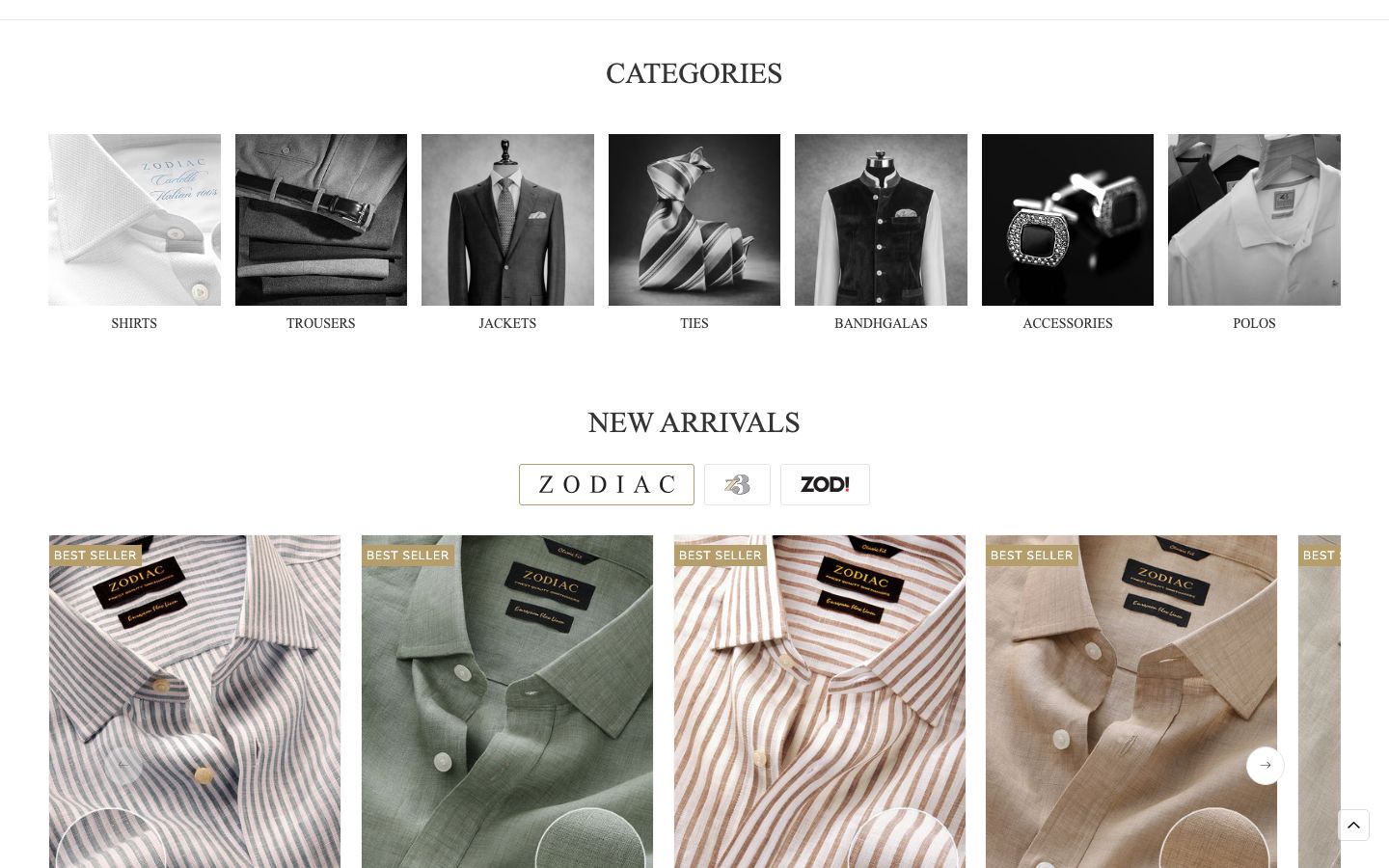
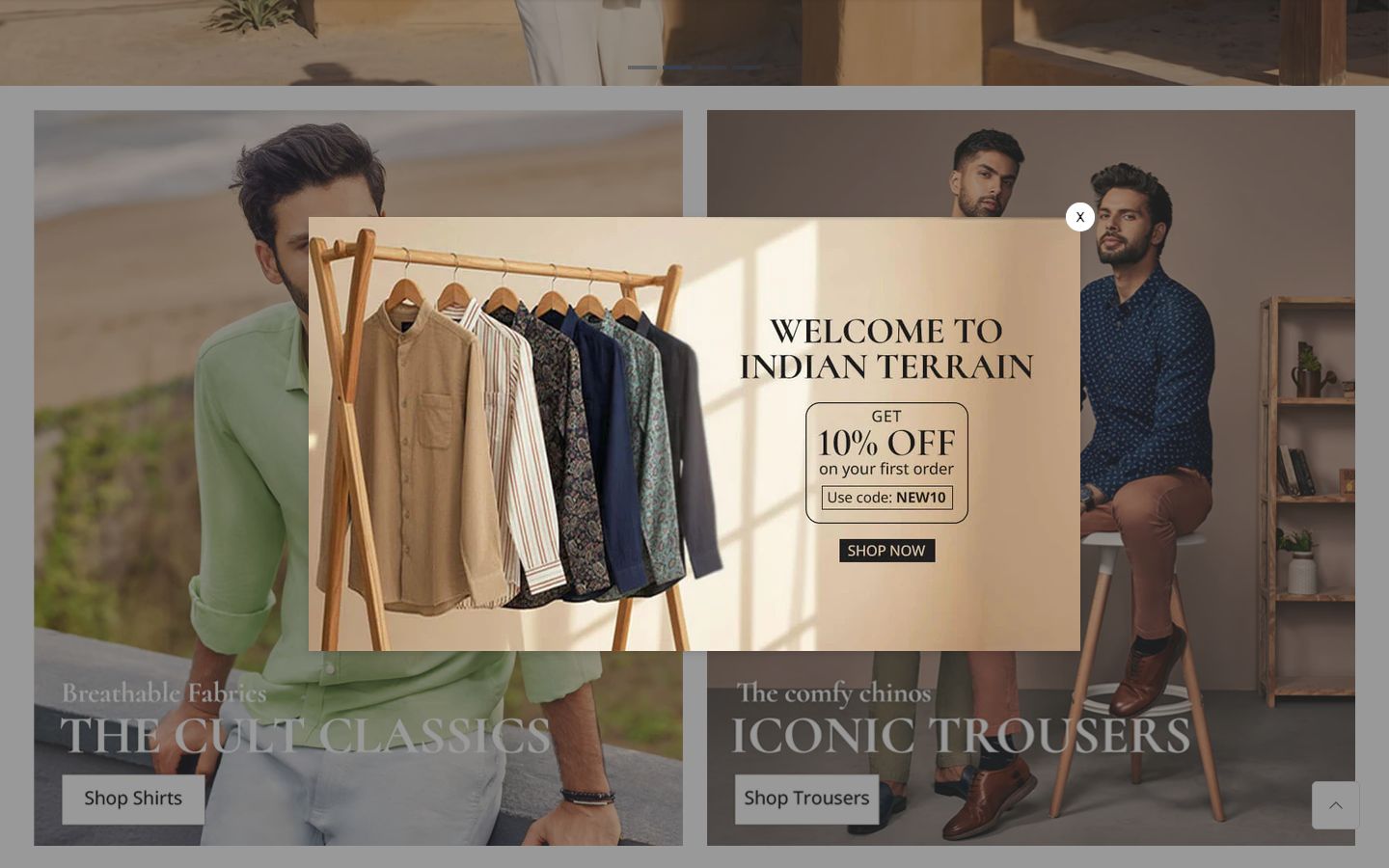
- Zodiac's homepage has no customer reviews section, no rating summary, no Instagram UGC feed, and no 'As Seen In' press mentions — a new visitor has no third-party proof that other people buy and love this brand.
- Since Zodiac has no review platform installed, even their PDP has zero social proof — meaning the entire site relies on product photography and brand copy alone to close purchase intent.
- Indian Terrain features a dedicated 'Customer Reviews' section on the homepage with aggregate star ratings and testimonials, directly addressing the most common purchase barrier: 'Is this brand good?'
- Zodiac targets working professionals at a premium price point — an audience particularly likely to research and compare before buying, making social proof disproportionately important.
- Install a review platform (Judge.me, Loox, or Okendo) to enable customers to leave photo reviews — this is foundational and unlocks social proof across homepage, collection, and PDP simultaneously.
- Add a homepage section showing aggregate ratings ('4.6★ from 2,000+ orders') and 3–4 featured customer testimonials with product photos — this can be built immediately even before collecting many reviews by featuring verified early customers.
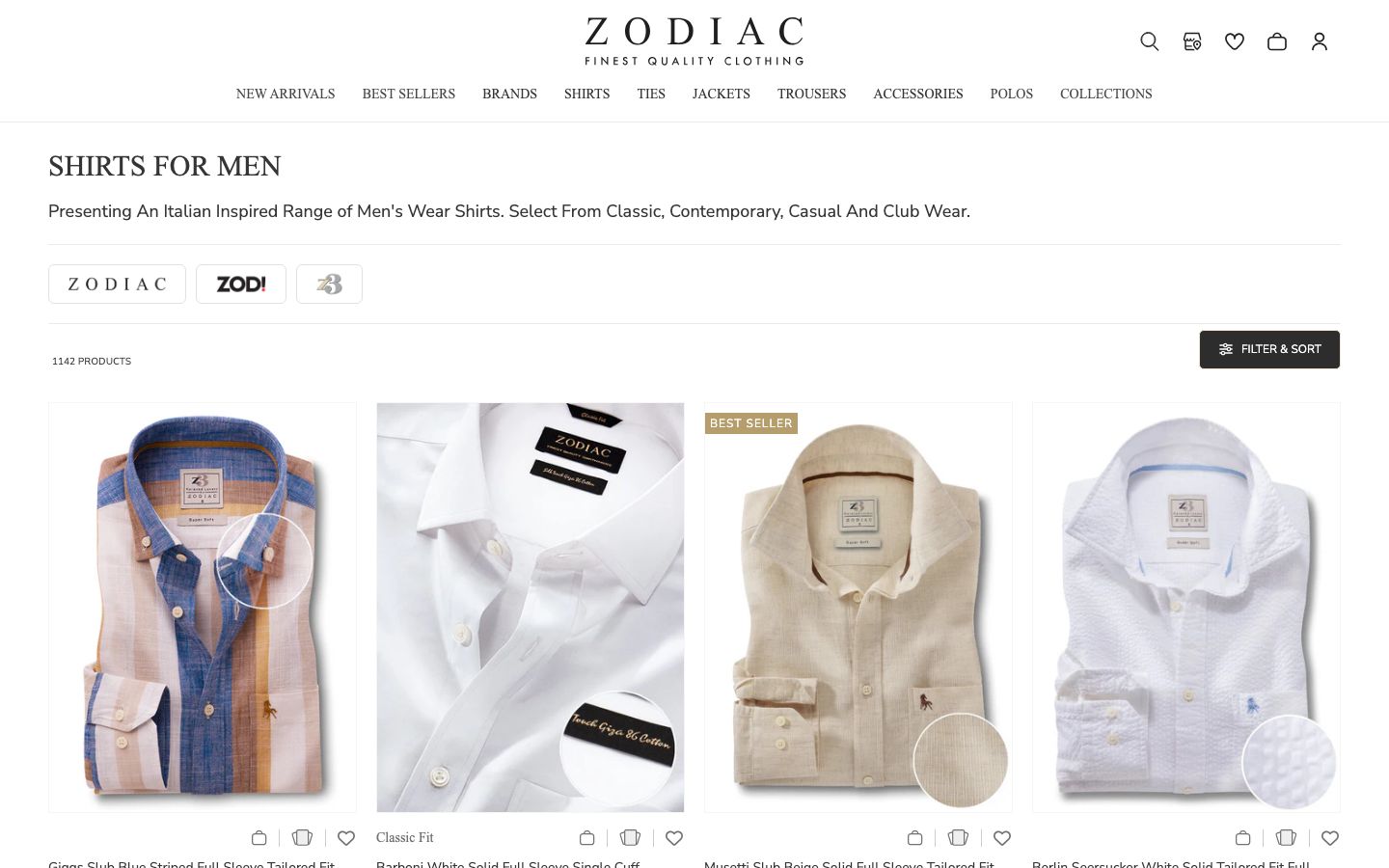
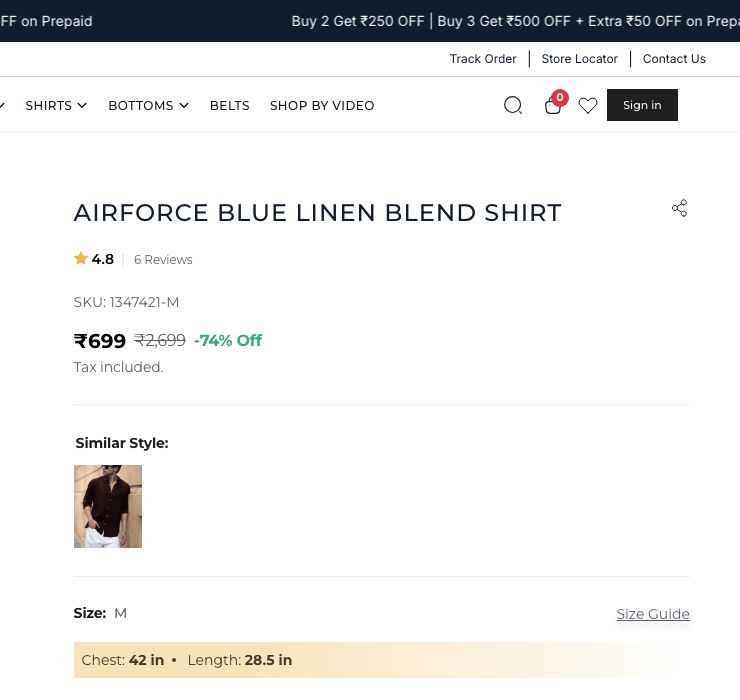
- Zodiac's collection cards show product image, product name, and price — nothing else. There are no star ratings, no review counts, and no social proof signals to indicate which products are popular or well-reviewed.
- Star ratings on product cards act as a visual trust signal during the browse phase, helping users shortlist confidently without opening every PDP — their absence slows decision-making.
- Snitch and Indian Terrain both surface star ratings (e.g. '4.5★ (218)') directly on collection page cards, allowing visitors to filter by quality signals before clicking through.
- Since Zodiac has no review platform, ratings on cards cannot be enabled until reviews are collected — this is a downstream effect of the missing review app identified in the PDP section.
- Install Judge.me or Loox first (as recommended in the PDP review finding), then enable the 'Show ratings on collection cards' setting — this typically requires zero additional development once a review app is active.
- Until enough reviews are collected, consider surfacing a 'Best Seller' or 'Staff Pick' badge on top-performing SKUs as a proxy trust signal on collection cards.
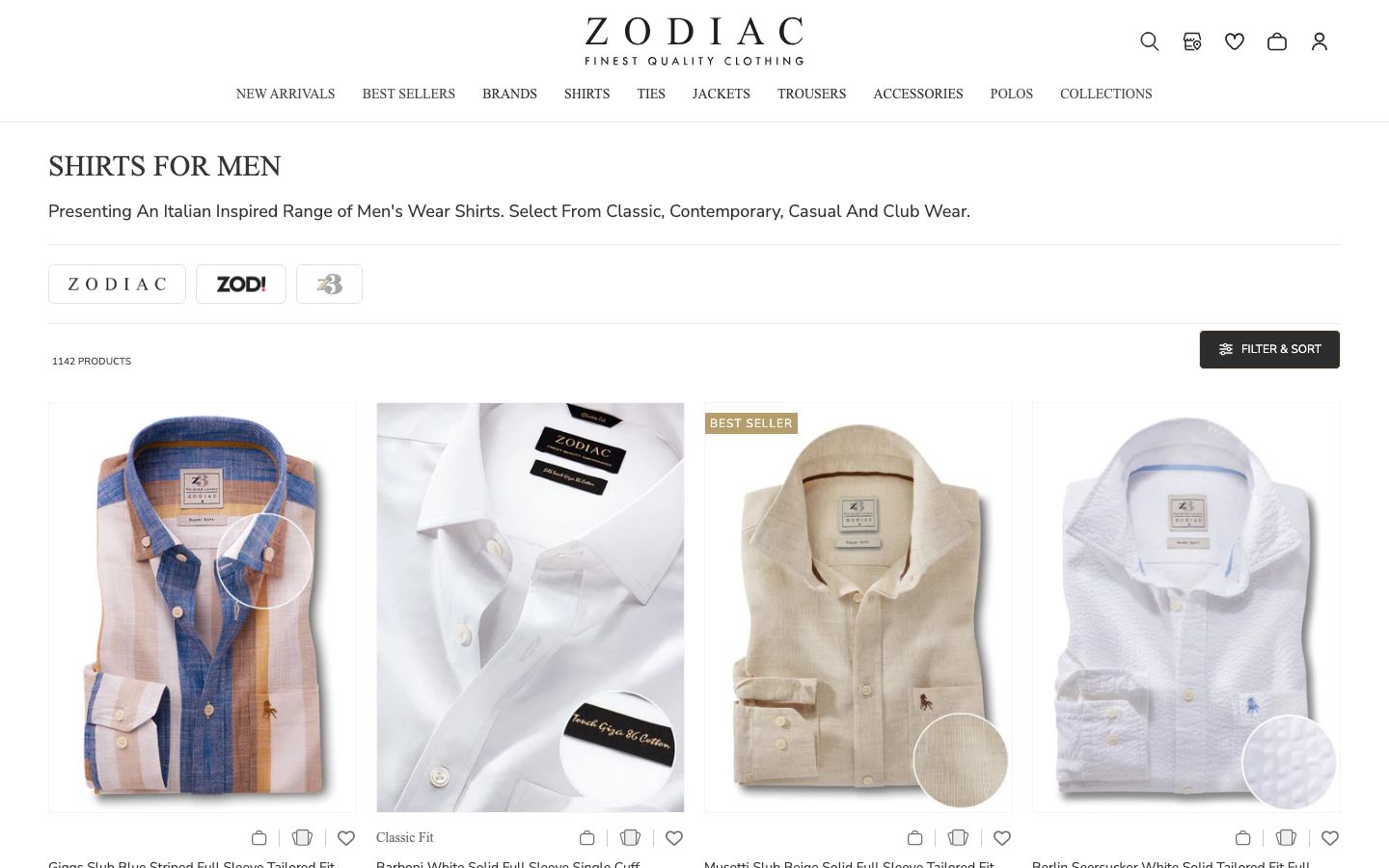
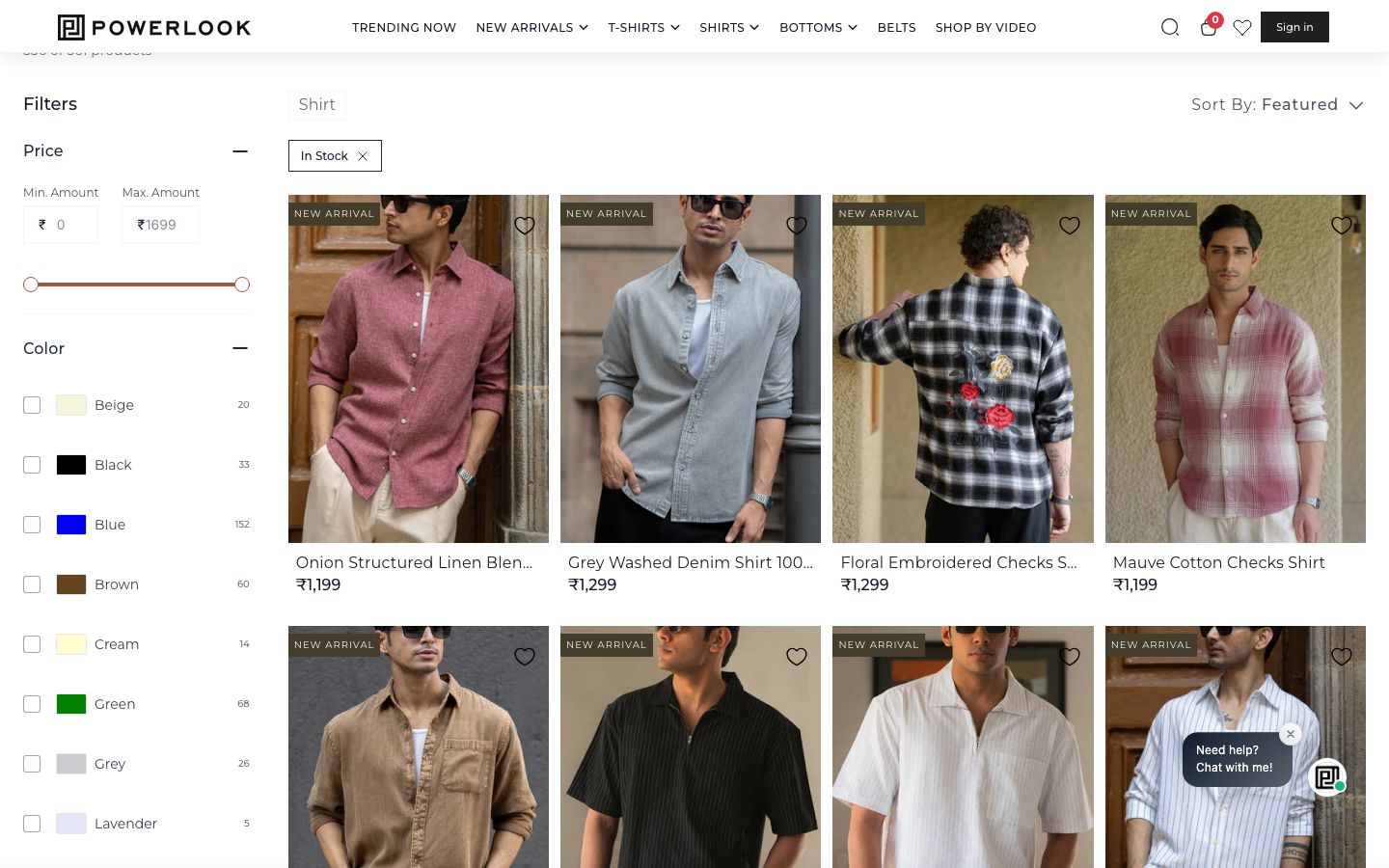
- Zodiac's collection page requires users to click through to a PDP to add any item to cart — there is no hover-state quick-add button or size selection modal on the collection card.
- For returning customers or users who already know their size, quick-add eliminates an extra page load and back-navigation, improving ATC rate from the collection by 10–15%.
- Powerlook implements a quick-add icon on hover that opens a size selector modal directly on the collection page, allowing high-intent browsers to add items in 2 clicks rather than 5.
- Fashion is a high-browse category — shoppers often evaluate 8–15 products before deciding. Each unnecessary PDP visit increases bounce probability for lower-intent users.
- Add a quick-add icon (bag icon) to collection card hover states that triggers a size-selection drawer or modal — available as native functionality in most Shopify themes or via apps like Quick View by Hulk.
- For size-based products like shirts, the quick-add should display available sizes (38–46) and allow single-click add to cart with the last-used size pre-selected.
- Zodiac has no review app installed (confirmed via JavaScript script tag inspection: no Judge.me, Loox, Yotpo, Okendo, or Stamped scripts loaded). Every product page shows zero stars, zero reviews, and no rating summary.
- Reviews are the single highest-ROI conversion lever in fashion e-commerce — 95% of shoppers read reviews before purchasing, and products with 5+ reviews convert at 270% higher rates than products with none (Bazaarvoice).
- 10 out of 10 top fashion stores in the India benchmark have a review platform enabled — this is not a differentiator but a baseline expectation for any direct-to-consumer fashion brand.
- Zodiac's premium price point (₹3,000–₹9,000 per shirt) makes reviews especially critical: the higher the purchase risk, the more validation a buyer needs before committing.
- Install Judge.me (free plan available) or Loox (photo-first reviews) immediately — these are native Shopify apps that can be live within hours and auto-email post-purchase review requests.
- Import any existing reviews from marketplaces (Myntra, Amazon) or collect from loyal customers via a targeted email campaign to seed the platform before going live.
- Enable review widgets on PDP (star rating above price, full review section below product details), collection page cards, and homepage — all powered by a single app installation.
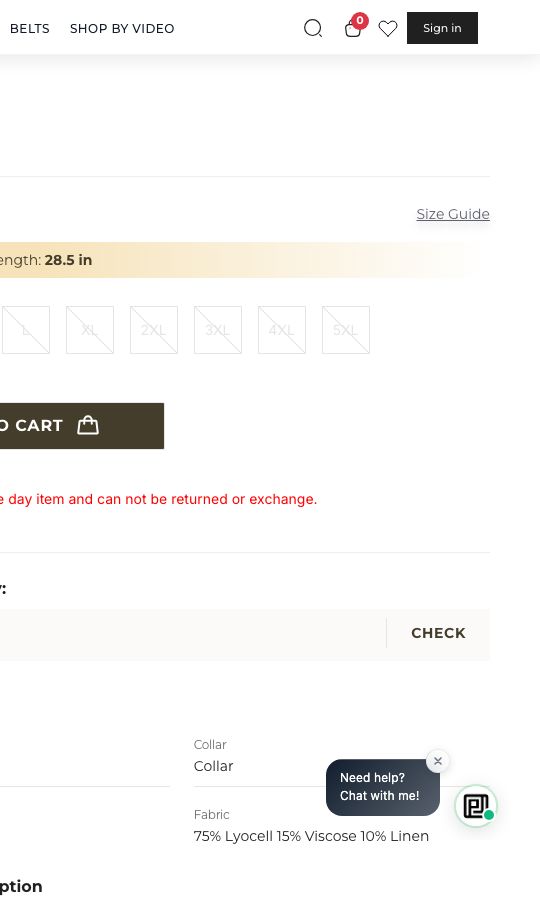
- Zodiac's PDP has no sticky ATC bar on mobile — confirmed via JavaScript DOM inspection (`hasStickyAtc: false`). As users scroll through the product description, FAQs, and cross-sell sections, the primary purchase action disappears from view.
- 9 out of 10 top fashion stores in the India benchmark implement a sticky ATC bar on mobile — it is considered a standard feature, not a differentiator.
- Mobile accounts for the majority of fashion e-commerce traffic in India — when the ATC button scrolls away, high-intent users must manually scroll back up to purchase, creating friction that directly reduces conversion.
- Zodiac's PDPs are content-rich (4 product images, craft details, FAQs, cross-sell sections) — the longer the page, the greater the impact of a sticky ATC, as the primary CTA moves further from where the user finishes reading.
- Implement a sticky ATC bar that appears on mobile once the user scrolls past the main ATC button — this bar should show product thumbnail, selected size, price, and a full-width 'ADD TO CART' button.
- The sticky bar should be fixed to the bottom of the viewport and include the key purchase signals: product name (truncated), size selected, and price — so users don't need to scroll back up to confirm what they're buying.
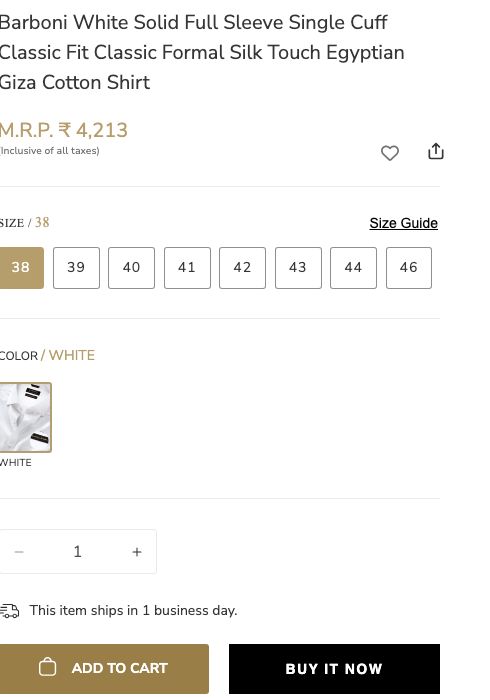
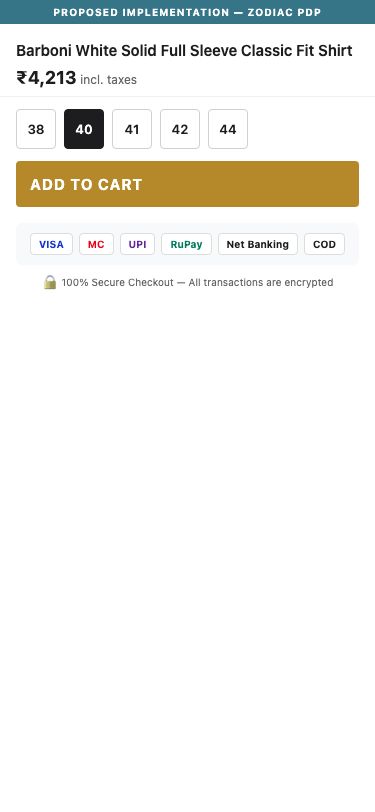
- The area below Zodiac's ATC button shows three product craft icons (Mother of Pearl buttons, 21 stitches per inch, German interlinings) — these are quality signals, not purchase security signals.
- There are no payment method icons (Visa, Mastercard, UPI, RuPay, Net Banking), no '100% Secure Checkout' badge, and no SSL/security indicator near the purchase action — the most common point of payment hesitation.
- For a ₹4,000+ purchase from a less well-known online brand, users actively look for evidence that their payment is safe and the brand is legitimate before clicking 'Add to Cart'.
- 5 out of 10 top fashion stores include a row of accepted payment method icons directly below the ATC button — this is a simple static image that requires zero development work.
- Add a row of payment trust icons below the ATC button: Visa, Mastercard, UPI, RuPay, Net Banking, COD — these can be a single static image or Shopify liquid icons.
- Include a brief trust line above or below the icons: '100% Secure Checkout' with a lock icon — this adds purchase confidence without cluttering the page.
- Consider replacing one of the three craft icons with a returns/free-shipping badge in the same style, since logistics trust is as important as product quality trust at the moment of purchase.
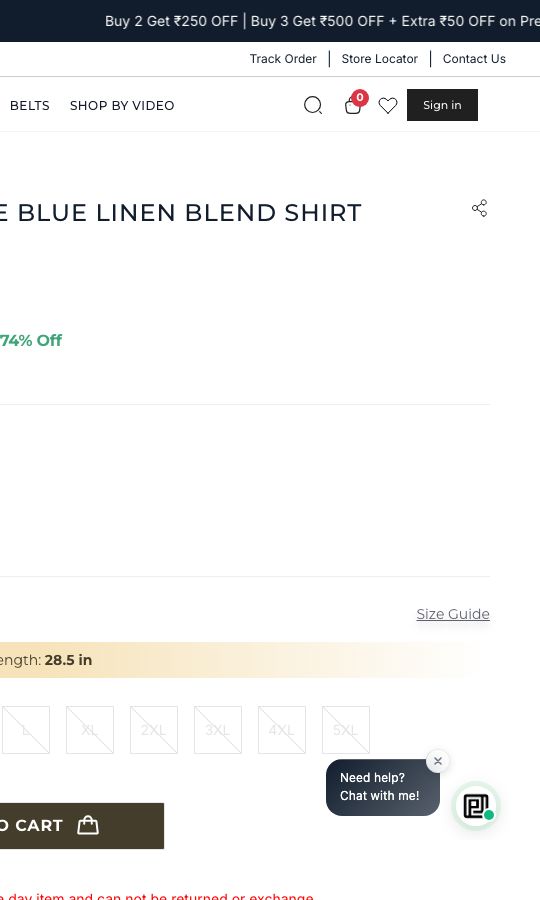
- Zodiac has no EMI or BNPL widget on any PDP — confirmed via full-page text search (no mention of EMI, Bajaj Finserv, ZestMoney, Simpl, LazyPay, or 'Pay Later' anywhere on the product page).
- At ₹3,000–₹9,000 per shirt, Zodiac's pricing is in the range where EMI significantly reduces perceived cost: a ₹4,213 shirt becomes ₹527/month over 8 months — a fundamentally different purchase decision.
- Powerlook surfaces a 'No Cost EMI' option starting at ₹499/month directly below the price on their PDPs, reducing sticker shock and increasing ATC rates for high-value items.
- 5 out of 10 top fashion stores in India have enabled BNPL or No-Cost EMI on PDP — particularly important for the premium segment where price is the primary objection.
- Integrate a BNPL provider such as Simpl, LazyPay, or Bajaj Finserv EMI network — these are available as Shopify plugins and typically require minimal integration effort.
- Surface the EMI option directly below the price as 'EMI from ₹XXX/month' with a clickable link that expands EMI plan details — this reduces sticker shock without requiring users to proceed to checkout first.
- Even if full BNPL integration is not immediate, add a 'No Cost EMI available on all card payments' text line below the price — this sets expectation and reduces cart abandonment.
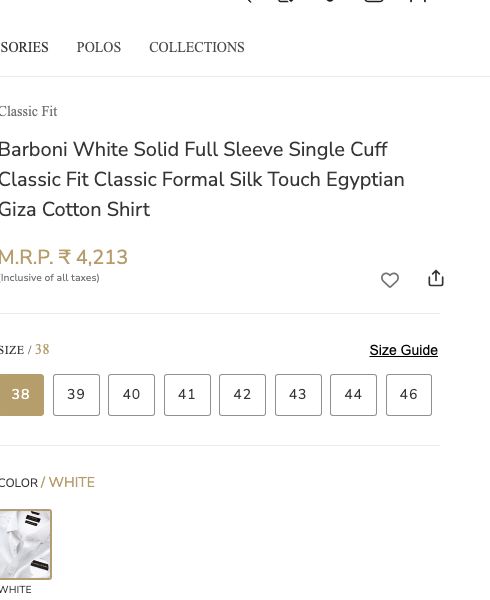
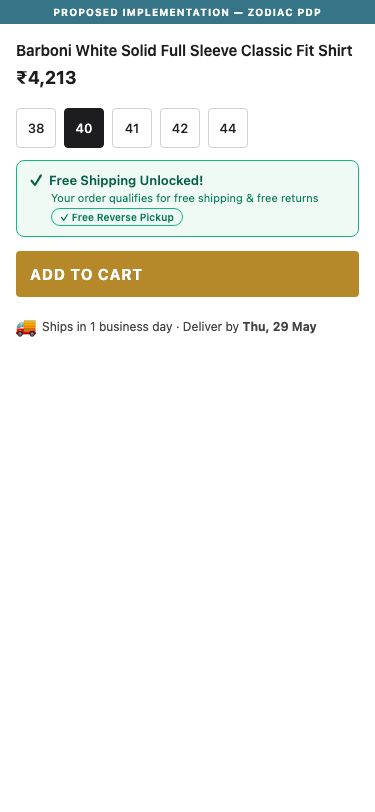
- Zodiac offers free shipping and free reverse pickup on all orders above ₹999 — a valuable proposition — but this is only visible on the cart page in a small text line, not surfaced during the browsing and purchase decision phase.
- A progress bar on PDP (e.g. 'You're ₹500 away from free shipping') motivates users to add complementary items — ties, belts, trousers — before checking out, naturally increasing AOV.
- Zodiac's 'Perfectly Paired With' cross-sell on PDP is a strong foundation for this: a free shipping nudge + cross-sell combo is particularly effective ('Add a tie and get free shipping on your order').
- At ₹999 threshold and Zodiac's average shirt price above ₹3,000, most single-item purchases already qualify — the bar's value is psychological reassurance ('✓ You've unlocked free shipping') rather than purely upsell.
- Add a free shipping confirmation message near the ATC button for users whose cart already exceeds ₹999: '✓ Qualifies for Free Shipping & Free Returns' — this reduces one purchase hesitation at the moment of decision.
- For users with empty carts browsing PDPs, show a progress bar: 'Add ₹XXX more for free shipping' — this can be implemented via Shopify cart attribute or a Rebuy-powered banner (Rebuy is already installed).
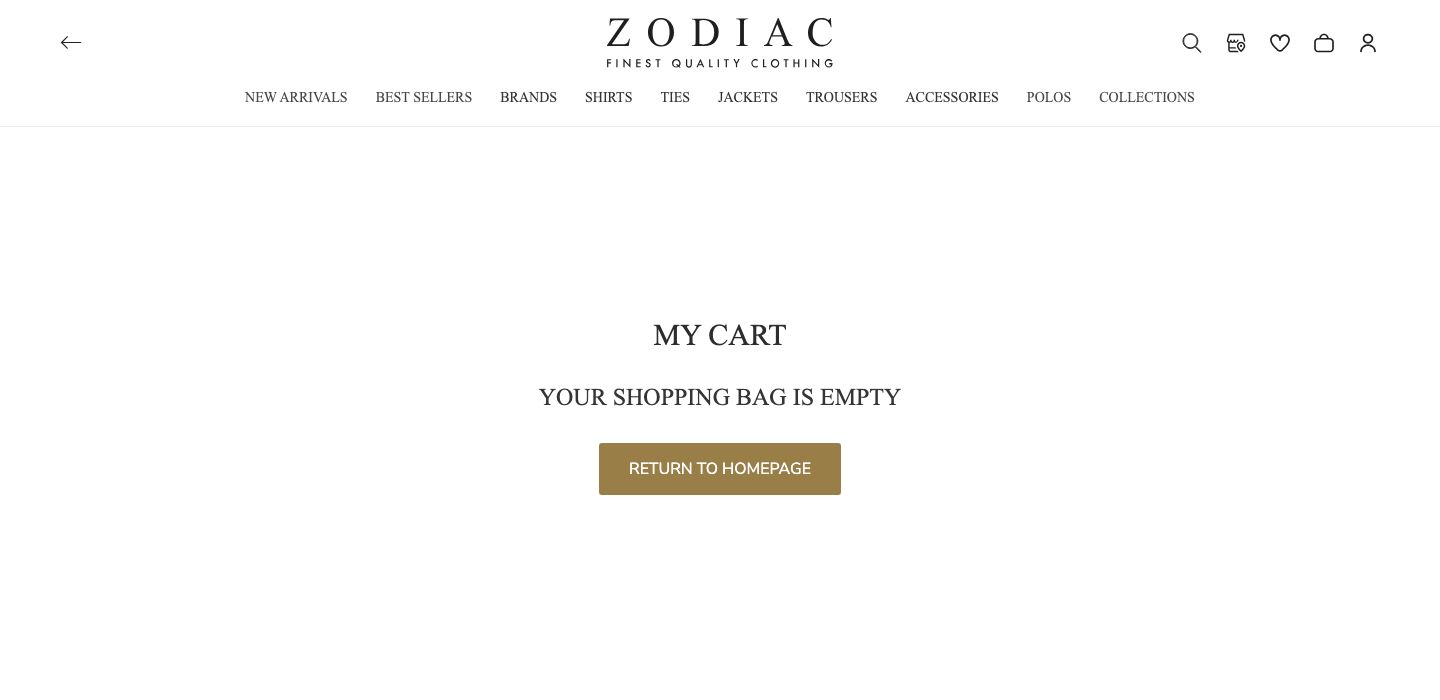
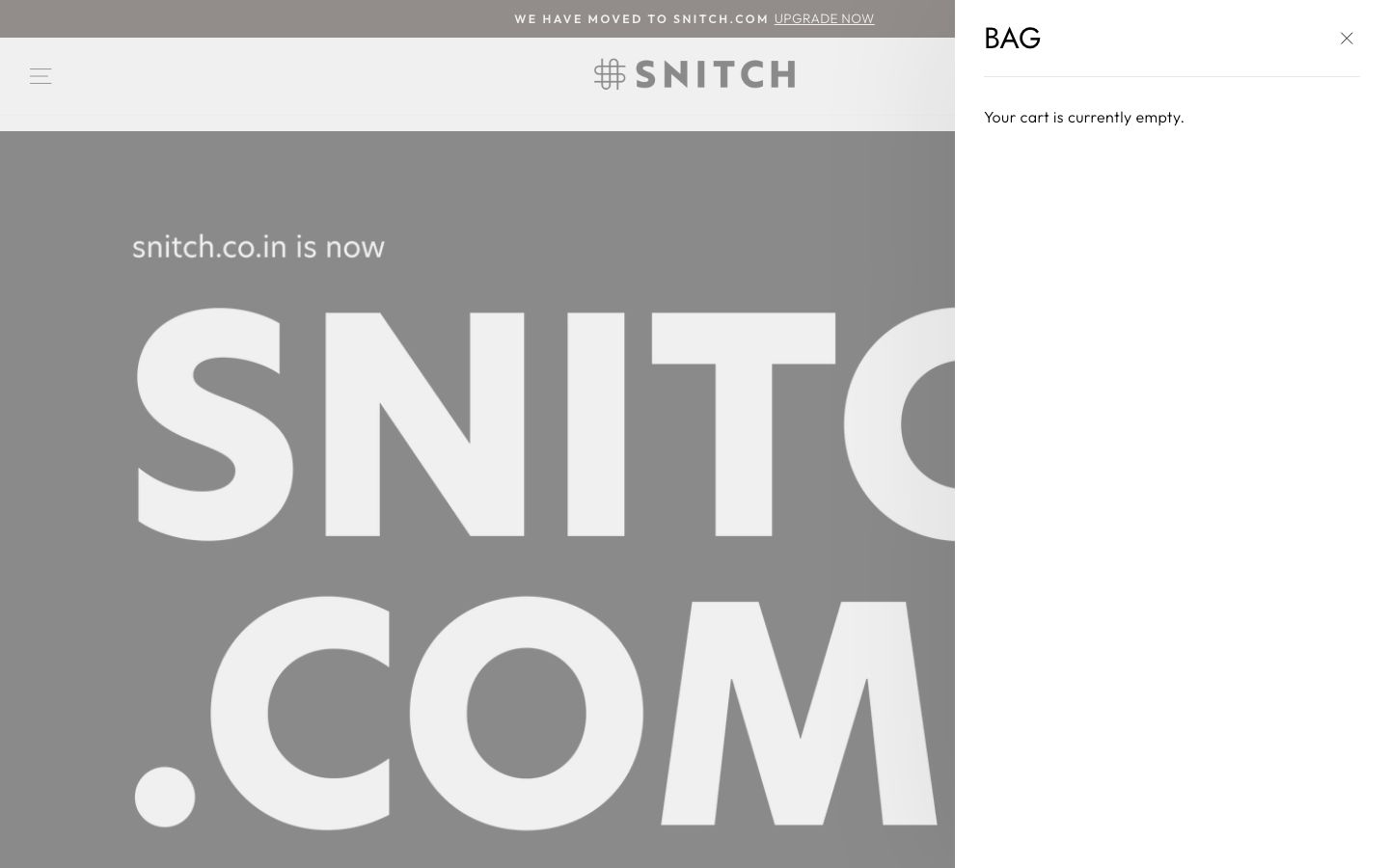
- When a user adds an item to cart on Zodiac, they are redirected to a full /cart page — there is no slide-in cart drawer or mini cart modal (confirmed: no cart-drawer element exists in the DOM).
- 8 out of 10 top fashion stores in India use a cart drawer that slides in from the right while keeping the product page visible — this allows users to continue browsing or add complementary items without losing their place.
- A full-page cart redirect has a significant psychological cost: users who land on the cart page must actively navigate back to continue shopping, and many do not — this reduces multi-item order rates.
- Zodiac's 'Perfectly Paired With' cross-sell recommendations (tie, trousers, belt) are only visible after reaching the cart page — a cart drawer would surface these recommendations while the user is still in browse mode, increasing uptake.
- Implement a slide-in cart drawer that appears when ATC is clicked — it should show cart items, subtotal, a 'Proceed to Checkout' CTA, and the 'Perfectly Paired With' cross-sell within the drawer itself.
- Use Rebuy Engine (already installed) to power cross-sell recommendations inside the cart drawer — Rebuy natively supports cart drawer integration and can show 'Complete the look' recommendations in real time.

- Zodiac's cart billing summary shows subtotal, order total, and a 'PROCEED TO CHECKOUT' button — with only 'Free Shipping | Free reverse pickup' text below. No payment method icons, no security badge, and no trust signal.
- Cart abandonment peaks at the payment step — users who have added items but not yet paid are the highest-intent segment, and the most common hesitation point is 'Is it safe to pay here?'
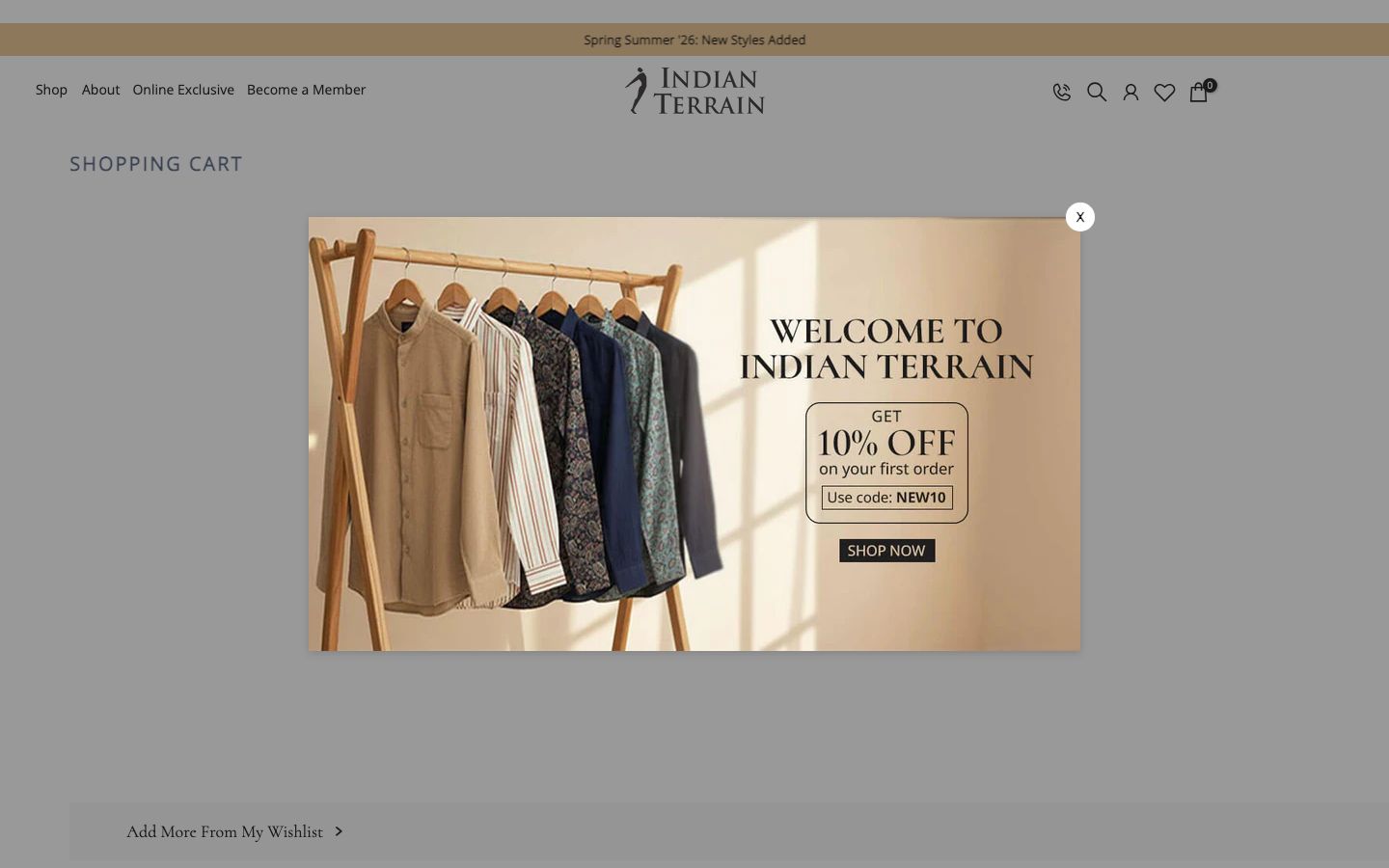
- Indian Terrain shows accepted payment icons (Visa, MC, RuPay, UPI, Net Banking) and a '100% Secure Payment' badge directly below their cart checkout button, directly addressing last-mile hesitation.
- The omission is especially noticeable because Zodiac's checkout button is bold and prominent — the surrounding whitespace makes the absence of trust signals more visible, not less.
- Add a row of payment method icons (Visa, Mastercard, RuPay, UPI, Net Banking, COD) below the 'PROCEED TO CHECKOUT' button — this is a static image asset, zero development cost.
- Enhance the 'Free Shipping | Free reverse pickup' line to include a 'Secure Checkout' lock icon, reinforcing safety at the exact moment of financial commitment.
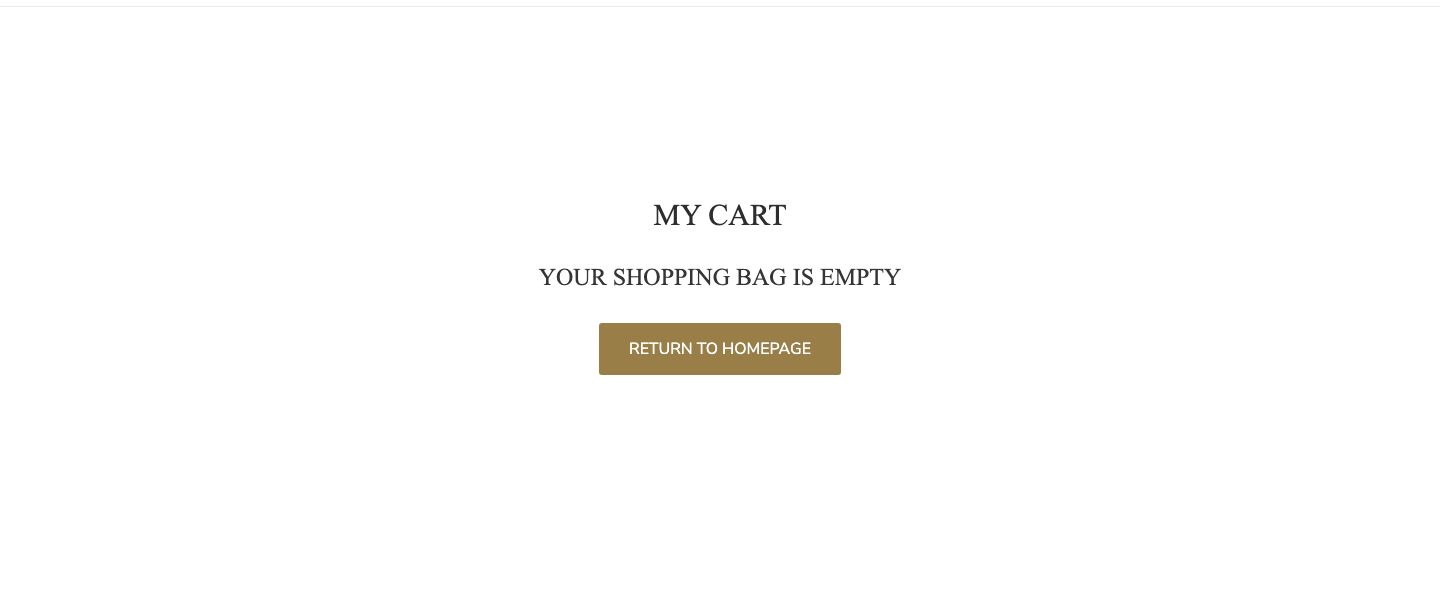
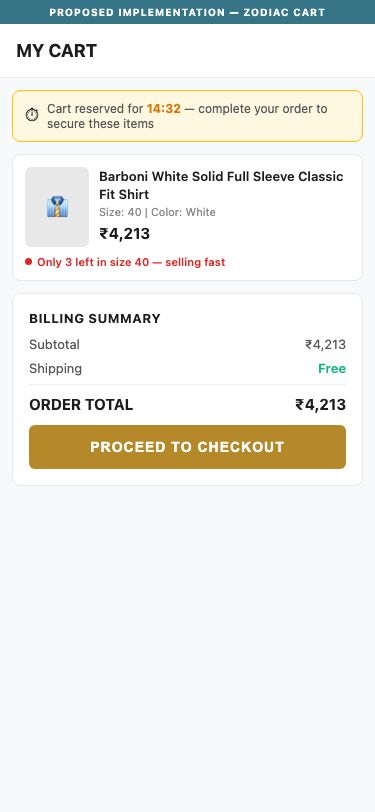
- Zodiac's cart page has no urgency elements: no 'Only X left in stock' message, no 'X people viewing this item', no countdown timer for a limited offer, and no 'Added to wishlist by Y others' social proof.
- Cart abandonment is highest during the consideration window — most users who abandon carts do so within 30 minutes of adding an item. A well-placed urgency signal (e.g. 'Low stock') during this window has an outsized recovery effect.
- For a craftsmanship brand with limited production runs like Zodiac, stock-based urgency is particularly authentic and believable — 'Only 2 left in your size (38)' would be genuinely useful information, not manufactured pressure.
- Snitch uses 'Low Stock' badges on both collection cards and PDPs, and surfaces stock levels in the cart — creating a consistent urgency signal throughout the funnel.
- Add a stock indicator below each cart line item: 'Only 3 left in this size' — this is available via Shopify inventory APIs and is particularly credible for a brand with curated, limited-run shirts.
- For items the user has had in cart for 10+ minutes without checking out, trigger a subtle 'Your cart is reserved for 15 minutes' or 'High demand — complete your order' message via Rebuy (already installed).
App Ecosystem
What's installed vs what's missing from best-in-class Fashion & Apparel stores
Present (3)
Missing (5)
App Stack Assessment
Zodiac's app ecosystem is lean but strategically incomplete. Rebuy Engine is a strong asset — its cross-sell recommendations are well-implemented on both PDP and Cart. Microsoft Clarity provides valuable behavioral data. However, the most impactful category — customer reviews — is entirely absent, creating a site-wide social proof gap that affects every page from homepage to checkout. Adding Judge.me (or Loox) and Klaviyo would unlock the highest-ROI growth levers available on Shopify.
Confidential — Prepared for Zodiac by Growisto | May 2026